Showing posts with label chelsea boots. Show all posts

Sunday, 24 April 2016

Part five exploring The Beatles style from 1961 to 1970, compiled and written by guest blogger, Harrison. In this instalment the Beatles embrace colour and patterns. You can also create your very own Beatles inspired look with this guide.

'65 - '66
Here Comes the Colour 
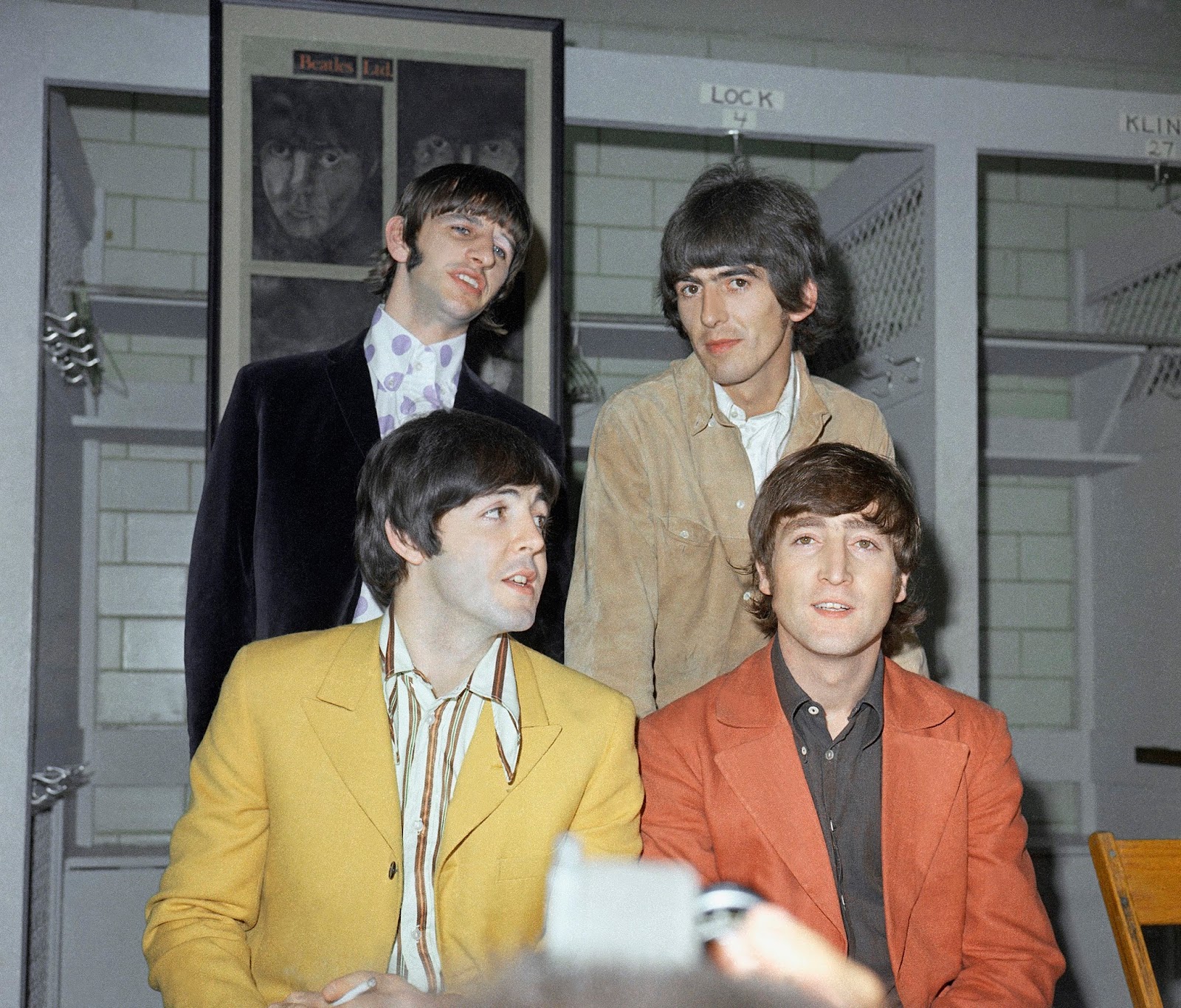
The Beatles, 1966
The Beatles Live at Budokan 
1966


"The Beatles saved the world from boredom."
- George Harrison 

In the winter of 1965, The Beatles released Rubber Soul, their sixth studio album. The LP was met with both commercial and critical success. It also marked a departure for the lads from their poppy sound and clean cut image. The cover was shot by photographer, Robert Freeman in the backyard of John Lennon's home, Kenwood. 

Freeman was a favorite photographer of the Beatles and consecutively designed five album covers for the group from 1963 to 1966. 

The Beatles stretched image tilted at a 'dutch angle' was happenstance. Freeman was projecting photographs of the band onto an album sized piece of cardboard. It fell slightly and stretched the photograph. The group liked the distorted effect and requested Freeman duplicate that for their album cover. 

Freeman asked illustrator Charles Front to design the lettering. Front was inspired by the title and wanted to invoke an image of a thick substance being pulled downwards. This stylized font became synonymous with the 1960s and mirrored Freeman's elongated album cover image of the Beatles. 


Sunday, 3 April 2016

Part four exploring The Beatles style from 1961 to 1970, compiled and written by guest blogger, Harrison. In this installment the Beatles move into military style and also into more casual attire. You can also create your very own Beatles inspired look with this guide.

'64 - '65
The In-betweeners 


The Beatles performing at Shea Stadium, New York.


"It's all sort of important in good ways and it's unimportant really in other ways."
- Ringo Starr


In 1964 through 1965, The Beatles were riding high on a wave of commercial and critical success. The lads performed at Shea Stadium in New York City on August 15th, 1965. In attendance were over 55,000 concertgoers, which made this the Beatles largest concert up to that date. 

A replica of the Beatles "Shea" jacket,
signed by Paul McCartney.
The Beatles continued to wear matching stage suits when they performed. The Shea Stadium suits are arguably their most iconic look from the mid 1960s. The military style single breasted tan coloured jacket with five brown buttons down the front, one smaller button on each chest pocket and also one button on each shoulder. The 'Wells Fargo' sheriff badge is optional. Underneath the jackets, instead of wearing dress shirts, they wore black t-shirts, which matched their black drainpipe trousers and "Beatle boots".  

However, their personal style had evolved and they became more easily identified through their interviews, photoshoots and personal appearances as individuals instead of one entity. Perhaps the best example of their individual style is contained in the second movie they starred in, which was also the first one in colour, Help! A comedy adventure that revolves around Ringo Starr's ring and the mysterious cult that will do anything to obtain it!


Sunday, 20 March 2016

Part three of our series exploring The Beatles style from 1961 to 1970, compiled and written by our guest blogger, Harrison. In this instalment the Beatles embrace their suited look. You can also create your very own Beatles inspired look with this guide.

'63 - '64
The Toppermost Of the Poppermost


The Beatles performing on the Ed Sullivan Show. 1964.


"So we got suits and ties and stuff and we went on like that. We gained a whole new audience and lost all the people who wanted us in leather."
- Paul McCartney 


In 1963, The Beatles were headed to the toppermost of the poppermost. Although there is debate over which single was their first U.K. number one hit, From Me To You went to the top of the charts in May. The group's first number one hit in America was I Want To Hold Your Hand. It entered the charts in January of 1964, and in the first week of February, just before their arrival, the song jumped to number one. 

The Beatles look evolved with their growing success and popularity. They no longer wore their round neck collarless suits. Their stage suits were always a variation of the traditional English Chesterfield, however, in early 1964 the lads had a special suit designed for them by Douglas Millings. The winged velvet collar suit was made for their debut American television performance on The Ed Sullivan Show on February 9th, 1964. They joined the club of their musical idols, Elvis Presley and Buddy Holly, who'd previously performed on the programme. The former sent them a telegram prior to their performance to congratulate them.  

The black suits they wore on Ed Sullivan were mohair, four button jackets with three button cuffs. They had no outer pockets, but the fully lined inside had double breast pockets. The double vent back allowed them to move more freely when they performed and also made running from fans easier. They continued to wear narrow ankle drainpipe trousers. The slacks also had tab adjustments on the waistband to make the drainies smaller at the waist and eliminating the need for a belt.

Sunday, 6 March 2016

Our new blog series by guest blogger, Harrison! This eight part series will explore The Beatles iconic looks from 1961 to 1970. You can also create your very own Beatles inspired look with this guide.

61’ - 62’
The Four Gene Vincents

611217_17.jpg
The Beatles in 1961. Photo by Albert Marrion
The earliest known footage of the Beatles performing in 1961. 
In this soundless 8MM clip, they are wearing their leather suits.

“...We went back to Germany and we had a bit more money the second time, so we bought leather pants and looked like four Gene Vincents, only a bit younger."

- John Lennon, ‘The Mersey Sound’

The Beatles emulated the style of Teddy Boys, a subculture of rebellious young men that had sprung up in the 1950s. They were product of American rock n’ roll music, and their style was a take on the dandies during the Edwardian period.

Teds wore knee length drape jackets, high necked collared shirts, skinny ties, drainpipe trousers and brogues or crepe soled creepers. They styled their hair with pomade and piled it high into a quiff.  

By the early 1960s the look had evolved. Young men were now wearing leather jackets - perhaps a call back to Marlon Brando in ‘The Wild One’ - and long pointed toe Winklepicker Shoes were in fashion. A pair of snugly fit drainpipe trousers were still popular.  

In the spring of 1961 The Beatles returned to Hamburg for a second time. They were contracted for a four month residency at the Top Ten Club and were reunited with their old friend, Astrid Kirchherr, a photographer they’d met during their first trip to Germany. The young woman was also the girlfriend of Stuart Sutcliffe, the group’s bass player at the time.

When he wasn’t performing with the band, Stuart would spend his time with Astrid. He was greatly influenced by her unusual sense of style. She was part of the existentialist movement, shortened to 'Exis' by John Lennon. They dressed in all-black, unisex clothing and wore unisex hairstyles. Stuart would borrow her clothes and mirror her look. In particular, he was taken with her tight black leather suit, and Astrid had one tailor-made for Stuart to wear when he performed with the group.  

His bandmates were knocked out by the leather suit wanted their own to match, but they couldn’t afford the expensive prices the leather shop downtown charged. They went to a affordable tailor in the St. Pauli district of Hamburg and ordered black leather drainpipe pants and matching velvet shirts. They accessorised their hard edged look with cowboy boots and occasionally wore pink caps that sat on the back of their quiffs.  

The Beatles return to Liverpool caused a stir of excitement. Their new look and sound set them apart from other groups and gave them the edge on the Merseyside music scene. Pretty soon others on the Merseybeat scene were also emulating the Beatles 'Hamburg' style.